- Leaf selection is the starting point of a cigar's life. The oiliness and elasticity of the wrapper, the layering of the filler — all hidden in the touch of the fingertips.
- Filling is about building a complex aerodynamic system. Book-style folding, density control, and avoiding the tunneling effect.
- Wrapping is the most mentally demanding stage. From binder to wrapper, every layer's tension is irreversible.
- Touch is the soul, but experience must be built on parameters. Moisture management, fermentation and aging — finding balance between numbers and senses.
Handcrafted Cigar Making: Key Feel and Technical Parameters for Leaf Selection, Filling, and Wrapping
Introduction: The Soul in the Fingertips
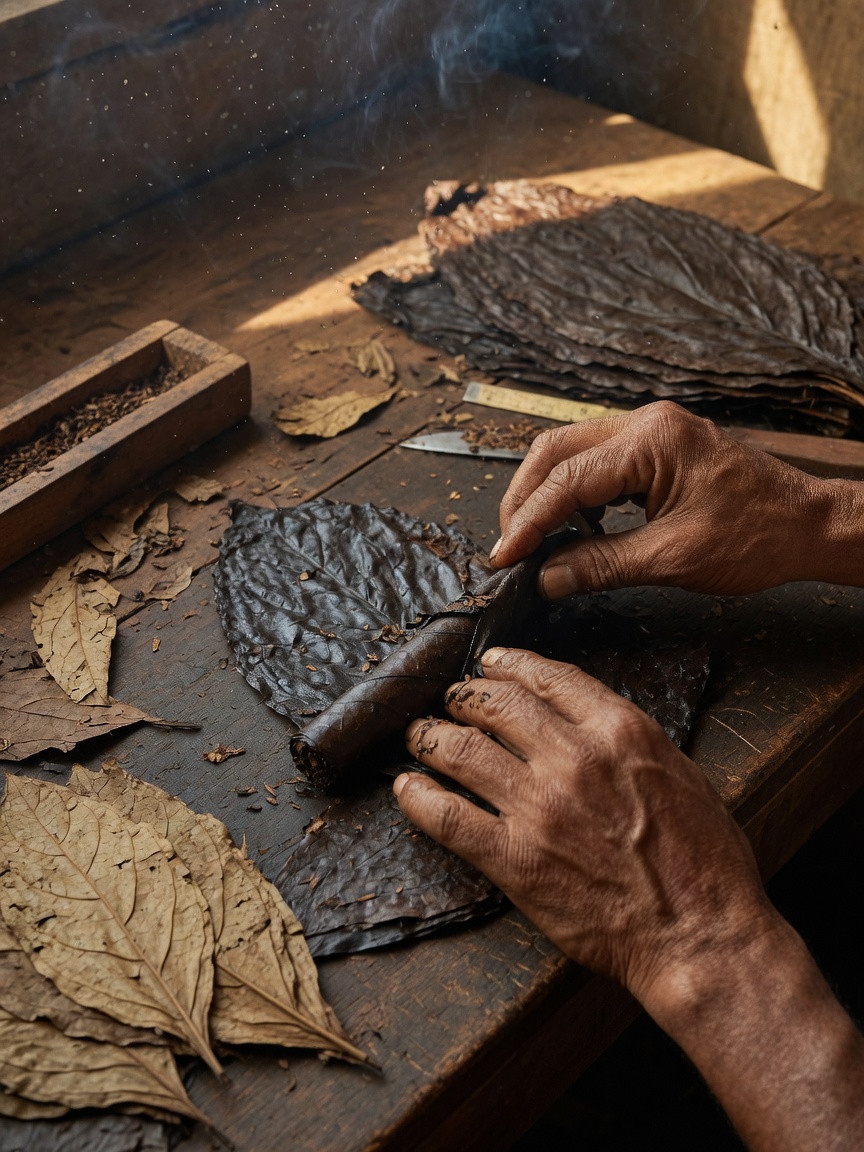
In the workshop in Estelí, Nicaragua, where the aroma of fermented tobacco lingers year-round, the air is always thick and warm. It is a complex scent mixing earth, licorice, and a faint acidity—perhaps dull to an outsider, but for a Torcedor who has immersed in this craft for decades, this is the breath of work.
Many believe that crafting a top-tier totally hand-made long-filler cigar (Totalmente a Mano Tripa Larga) relies on precise machines and constant temperature control. But to me, that is merely the foundation. The true soul of a cigar lies not in cold numbers, but in the tremor of fingertips gliding across a leaf, in the "touch" that cannot be fully defined by electronic scales or hygrometers.
Handcrafted cigar making is a game of tension, moisture, and density. From the gentle touch during leaf selection, to the press of filling, to the stretch of wrapping, every step demands the Torcedor to transform experience into almost instinctive tactile feedback. This article explores the most core technical details and sensory parameters of this craft.
Chapter 1: Leaf Selection — Distinguishing Ready from Raw Between the Fingers
Leaf selection is the starting point of a cigar's life. If the filler is the heart, then the wrapper is the skin.
Wrapper: Luxurious Texture
The wrapper is the most expensive and demanding part. We typically choose leaves grown slowly under shade-grown conditions, as their growth cycle is longer and the tissue more delicate.
When selecting wrappers, what I value most is "oiliness" and "elasticity." A superior wrapper should feel silky smooth when slid between the fingers, reflecting even oil distribution within the leaf. When you gently press the leaf, it should show "toughness"—neither making a sharp cracking sound like a dried fallen leaf (indicating severe lack of moisture), nor being soft and limp like soaked seaweed (indicating excess moisture).
A specific empirical indicator: the ideal wrapper moisture should be in a state where it "can bend but won't crack." I gently pinch the leaf edge with my fingertip; if the leaf can smoothly curl into a cylindrical shape without the slightest crack, and has a slight damping feel when springing back, it is a perfect wrapper.
Filler: The Skeleton of Flavor
If the wrapper determines beauty, then the filler determines depth. Filler selection emphasizes "layering."
In my blend, leaves from three dimensions are essential:
- **Ligero**: Grown at the top of the plant, thick leaves rich in oils. They are the engine of flavor and the slowest-burning part. When handling Ligero, one must feel its heavy "weight."
2. **Seco**: Grown in the middle, providing balanced aroma.
3. **Volado**: Grown at the bottom, thinner texture, good combustibility, used to regulate overall draw resistance.
When selecting fillers, I look not only at color but also at "thickness variation." If a Ligero leaf is too thin at the edge, it will cause "tunneling" during burning, leading to uneven combustion of the entire cigar.
Chapter 2: Filling — Building the Skeleton and Breath of Flavor
The filling process is essentially constructing a complex aerodynamic system.
Construction Art: Book Style and Accordion Style
To ensure every draw delivers even smoke, we cannot simply pile leaves together. Modern top-tier craftsmanship mostly uses the "Book Style" folding method.
Imagine folding each filler leaf longitudinally like book pages. This folding creates tiny, continuous air channels between the leaves. When you squeeze the bunch with your hand, you should feel a "resilient firmness." If it feels like squeezing a ball of cotton, the density is insufficient, and air will channel erratically; if it feels like squeezing a wooden stick, it is too tight and smoke cannot pass through.
Density Control and Avoiding the "Tunneling Effect"
The hardest part during filling is controlling the "center of gravity." I have worked in Estelí for many years and once encountered a batch of leaves with uneven moisture due to over-fermentation. Obsessed with density at the time, I compressed all the heavy Ligero leaves into the center. As a result, during burning, the center accumulated heat too quickly, burning through the outer layer and forming what is called a "tunnel."
The technical parameter to solve this: we must precisely calculate the overlap area of each leaf based on the ring gauge. For a 54-ring cigar, the total filler volume must remain compact while adjusting the folding angle to ensure a gentle pressure gradient from the foot to the head.
Chapter 3: Wrapping — The Game of Tension and Perfection
Wrapping is the stage that tests mental fortitude the most. When you pick up that precious wrapper leaf, you face an "irreversible tension."
Binder: The Structural Anchor
Before applying the wrapper, the bunch must first be tightly bound with a binder. The binder provides a stable physical framework. It must have high tensile strength to lock the filler leaves tightly in a spiral wrap, leaving no gaps.
Wrapper: The Art of Tension
When wrapping, the core lies in "uniform spiral tension." Starting from the foot, the overlap of each wrapper layer should be precisely controlled at about 1/4 inch (approx. 6 mm).
My favorite operational feel is that "tight wrapped sensation." When you hold the cigar being rolled between your thumb and index finger, you should feel a continuous, centripetal pressure. If this pressure suddenly decreases at some point, the tension in that wrap is insufficient, and side burn is likely to occur later.
An experienced Torcedor judges tension by observing the wrapper surface texture. If fine wrinkles appear, the tension is too high and the leaf may tear; if the surface is too smooth and looks loose, the tension is insufficient. The ideal state: the surface is smooth as a mirror, but pinching it gives a tight feedback.
Cap: The Final Seal
Finally, use natural starch glue to attach the cap. This seemingly simple step affects the entire cigar's seal. The cap must fit perfectly with the wrapper edge, without any gap; otherwise, during smoking, air will seep in from the side, disrupting the designed pressure balance.
Chapter 4: Parameter Precision — From Sensation to Numbers
Though touch is the soul, experience must be built on respect for physical parameters.
Moisture Management: The Art of Case
In my workshop, the hygrometer is my eye. The moisture content (Case) of cigar leaves is typically maintained between 65% and 70% relative humidity.
This is an extremely narrow window. If humidity drops below 60%, the wrapper becomes brittle and prone to cracking during rolling; if humidity rises above 75%, the leaves become too sticky, making rolling difficult and causing the final product to produce moldy or overly heavy smoke.
I have a habit: before starting large-scale work, I perform a "fingertip test." I take a sample leaf and curl it. If it holds its curled shape without any brittle sound, its moisture is in the ideal range.
Fermentation and Aging: The Magic of Time
Cigar quality largely depends on fermentation parameters. During pile fermentation, we must strictly control temperature. Filler temperature is typically controlled between 45°C and 55°C.
If the temperature is too high, nicotine will over-deplete, resulting in bland flavor; if too low, acidity and tar content cannot be effectively reduced, making the smoke harsh and pungent.
After rolling, the cigar must enter the aging stage. This is not just placing cigars in a humidor, but a process where different leaf layers interpenetrate and aromas integrate. For premium products, this process requires at least 2 to 6 weeks. During this stage, what we observe is the "roundness" of the smoke after aging.
Conclusion: Feel — The Unquantifiable Experience
In the digital age, people try to simulate everything with sensors. But in the world of cigar making, some things cannot be quantified.
That feeling of a heavy Ligero leaf in the morning sunlight; that tremor when sensing the wrapper tension reaches its limit through the fingertips; that intuition from squeezing the finished product to judge whether its internal air channels are smooth—these are things deposited through time.
Handcrafted cigar making is, at its core, using human senses to correct nature's errors. What we pursue is not absolute uniformity, but a vibrant balance within parameter constraints. Only when you have truly learned to "hear" the leaf's breath and "feel" the pulse of tension can you be said to have truly entered the door of this art.